Thursday, March 24, 2011

"Get Busy Living or Get Busy Dying"

Photo courtesy of Josh Pesavento under the Creative Commons License

"Get Busy Living or Get Busy Dying" is one of my favorite quotes from the movie The Shawshank Redemption.  When I cry in frustration at the obtuseness of those in charge of disseminating dietary advice to the masses (doctors, the government, companies touting "healthy" products, etc.), I have to take a step back and realize that all I can do is throw a stone into the water with my thoughts and hopefully cause a ripple.  As a CrossFit Kids coach and as a human being, I care about the health of our kids!

Childhood Obesity

Why is childhood nutrition such a hot topic?  Childhood obesity is on the rise.  Here is an interesting article on 10 Frightening Facts About Childhood Obesity. Their list is below.  For more detail on each, please check out the full article.
  1. Only 2% of kids in the U.S. eat healthy.
  2. Fast food consumption is rising.
  3. About 25% of kids don’t do any physical activity.
  4. Kids spend up to 5 hours daily watching TV.
  5. Obese children make poor students.
  6. The risk for heart disease jumps.
  7. Half of diabetic children are overweight.
  8. Sleep apnea is a growing threat.
  9. Health care costs are triple what they are for healthier children.
  10. Obese children will live shorter lives than their parents.
For many overweight kids and adults, junk food and sweets aren't the only cause: it's starch.  One reason is that high fructose corn syrup is in EVERYTHING, even starches like bread.  Check the labels--you'll be horrified.  Why we need to sugar everything we consume is another post, but for now, take it on good authority that high density foods like bread, pasta, rice, and potatoes give too much energy, and the excess carbohydrate turns to fat.  In reality, it isn't fat that makes us fat, but carbohydrate!  The old advice to eat a low fat and high carbohydrate diet hasn't gotten us out of the obesity epidemic; in fact, the epidemic has gotten worse.

I just got back from a talk given by Dr. Lustig of "Sugar: The Bitter Truth" fame, but I can't write up that smorgasbord of info at the moment.  Next time, Gadget, next time. Right now, the focus of this post is:

Step 1: We need to work toward the goal of replacing that starch AND SUGAR with vegetables and fruit--i.e. REAL FOOD.

How to Change

My advice is to start adding more vegetable and some fruit to a child's diet in a number of ways:
  • Veggie Hunt: Let your kids run wild in the produce section.  Anything they find, they can learn how to make with you.  Find a recipe and cook it together.  This gives kids a chance to be creative and try something new.
  • Make It a Family Affair: 
    • Eat vegetables as a family: make sure you are all eating the same healthy diet so you are a role model for healthy eating. 
    • Cook Together: make your kids a part of the process so they feel more connected to their food and the hard work it takes to prepare it. 
  • Pile in the Veggies: Incorporate vegetables into sauces, soups, chili, ragout, and anyplace you can add more vegetables without really noticing them.  Some parents find success pureeing vegetables into textures kids like better than when they are raw or cooked and whole. 
  • It's No Big Deal: Don't make a big deal out of dinner, just make it and serve it.  Don't highlight the changes you've made, just make it completely normal and natural to eat whatever you've prepared. 
  • Easy Favorites:
    • Tacos: Try taco night with lettuce leaves and have shredded cabbage, onions, and other vegetables as the toppings.
  • Don't Forget the Healthy Meat and Fat: Don't be afraid of meat and fat--it's those dense, high glycemic starches that we have to worry about.  Healthy fats are avocados, coconut oil, olive oil, pasture butter, nuts, and seeds.  Healthy meats are pasture-raised, wild-caught, and grass-fed. 
  • Label Hunt: Spring clean your pantry and fridge so it's free of unhealthy temptations.  Read labels--more than five ingredients?  Chuck it.  Something you can't pronounce/don't know what it is or where it comes from? Chuck it.  Added sweeteners?  Chuck it.  You can make this a family affair--kids can practice reading and get a kick from throwing away the crap. 
  • Drink Water: Water is the ultimate thirst quencher.  Anything with sugar, even if it's a "sports drink" or 100% juice, is no better than soda. To transition off the juices, try watering them down.  Unsweetened herbal teas are great and add a burst of flavor to water hot or cold.  
  • Be the Boss: You are the boss when it comes to food in your house.  Use your choices to nourish, not harm.  
  • Cultivate an Appreciation for Healthy Food: Eating healthy is a positive feedback loop--you feel better and better.  Eating poorly is a negative feedback loop--you feel awful, BUT it positively effects your desire for those poor choices.  Break the cycle and eat healthy choices to get yourself back on track.  Substitute your sugar cravings for fruit--such as a decadent, healthy snack: Berry Bowl--and slowly cut back by adding more veggies.  
  • Reward Excellence: You can give a reward for the family's effort--perhaps a once a week cheat meal at a restaurant or ice cream for dessert one night. Some people don't like a reward, but for me, if I can stay healthy all week, I have earned a cheat meal or dessert and feel pride that I earned it.  You can also make your "cheat" meals really not so much of a cheat if you buy or make homemade treats still low in sugar and starch and gluten-free--they'll definitely make you feel better than a blow-out gluten cheat.  On the other hand, you can also just forgo the cheat altogether and make it family plan to get healthy and stick with it. 
  • Help!  Here are some helpful resources:
    • Get Your Kids Off the Crack--my soapbox stand against sugar and refined carbs. Check my sidebar and browse my label cloud for more topics of interest. 
Parenting Blogs:
    • Everyday Paleo: a mom with it all going on--easy paleo recipes for the whole family, functional fitness, and her own book!
    • Organic Thrifty:
    • Primal Kitchen with amazing lunchbox ideas, recipes, and pictures!
    • Joyful Abode: a very professional smorgasbord of information and recipes
    • The Paleo Child: with the title "A Paleo life from birth to breastfeeding and beyond."
    • The Cave Kitchen with a great Learning to Cook section categorizing the tasty recipes.
    • Enjoying Healthy Foods Says Lindsey: "I started this blog to share my experiences (recipes) good and bad through our major change. I am not scared to share my FLOPS with you... as this is a learning experience for me."
    • Paleo Mama "I am not a professional chef.  I am not a doctor or a nutritionist. I am a mom who is cutting through the propaganda of the American “healthy” diet, to create REAL natural meals for myself and my family."
    • Primal Mama Cooks...and dishes on life "Seeing the positive changes in my health and strength led me to explore creating healthy, paleo-style recipes to share with you."
    • Paleo on a Budget "How a family of three eats frugally while following the Paleo Diet."
    • Life as a Plate: amazing, beautiful recipes and posts
    • Paleo Parents: delicious and colorful recipes and some helpful parenting tips.  I like their sidebar intro: "A practical approach for modern day families to eat from the Paleolithic period. It's not about a diet. It's not about "no" grains, dairy and sugar. It's about eating healthful, wholesome food for your family to look and feel their best. It sounds hard and overwhelming, but one (easy) step at a time you can get there, too."
    • Paleo Chronicles: 
      • Part 1 Says Patty: "In this series I plan to get down to the nitty gritty - what's worked, what hasn't, where I'm going and where I'm at with my own children."
      • Part 2 Says Patty: "Like I said in my first post, any child over the age of 5 is gonna resist if their food options are suddenly changed.  I took a different stance and gave my kids the same time, education and choice that I had when I chose to eat healthier."
So I hope I helped give you some starting ideas and support for choosing this path to nutrition and health.  Life's a journey--you just have to take the first step and if you fall off the path, just pick yourself up and get back on.

If you write or know of any other parenting blogs to share here as a resource for others, please write a comment and I'll add them to the list.  Please let me know how your journey is going for you!

Thursday, March 10, 2011

Southern Cooking Classic: Collard Greens


Collard Greens are definitely a rare menu item outside the South, but they don't have to be in your diet!  What can be wrong with bacon and greens--two of my favorite foods!

The traditional recipes use a smoked ham hock, but since my husband and I had recently taken a butchering class offered by the Pig Wizard, we have cuts from half a pasture-rasied pig in our freezer (it actually fit in our refrigerator freezer!).  A few portions went home with the Pig Wizard to cure, since he has the set-up.  After sampling some dried, cured meats he brought along, ours will be well worth the wait!

I cannot speak highly enough of the incredible opportunity it was to better connect with our food and play a role in the process of bringing it to our plate.  The 8-hour class was an eye-opening experience to see inside our food and how to parse it into cuts.  There were no cleavers and we only used the saw a couple of times--with finesse of the knife and careful work, you can render elegant cuts.  This was respectful butchering and in its craftsmanship and skill, an art form.

We devoured the carnitas we made from the butt or pork shoulder--omg is fresh, quality pork sweet and delicious!  We cut out the shoulder blade that was embedded in our carnitas meat and reserved it for our collards, leaving some meat attached.  This is a great use for the bone if you buy a bone-in pork shoulder or pork butt, which is often the case in some markets.

To supplement the pork bone, which we felt was a little sparse, we added a pound of bacon.  Yes, a full pound.  And it was awesome.


The collard greens are a hearty green you can find around the chard and kale.  They are related to broccoli and cabbage, so they have similar benefits such as vitamins A, C, and K, and calcium.  These veggies are also potent cancer fighters, as a 2006 study published in Cancer Research indicates:
Epidemiologic evidence suggests that high dietary intake of Brassica vegetables, such as broccoli, cabbage, and Brussels sprouts, protects against tumorigenesis in multiple organs. 3,3'-Diindolylmethane, one of the active products derived from Brassica vegetables, is a promising antitumor agent. 
Collard Greens recipes involve boiling the collards, but don't leave that liquid behind when you serve them!  Don't throw out the baby OR the bathwater in this case!  That liquid, called "pot liquor" or "potlikker," is an extremely nutritious broth with the vitamins leached from the cooked greens.  The loss of nutrients is one reason why I never boil or blanche my veggies, except in a soup--I try to keep as much of the nutrients in the food as possible and if they are released during cooking, I make sure to use that liquid.  In the case of pot liquor, it is rich and delicious--you don't want to waste a drop!

My husband was the driver in this recipe--and boy am I lucky to feast on this incredible creation of his!  He scoured the recipes out there and mashed together the ingredients we like best.  I took the revered role as sous chef and taster.  He is a great cook, and cooking together is so much fun, even in our small kitchen.  We always manage to wind up laughing and having a good time.  Just sharing the time together is infinitely precious.

So without further ado, here is our recipe:


Collard Greens and Bacon
Healthy, hearty greens paired with bacon--this is a heavenly match you'll soon devour!
Prep Time: 15min. or less
Cooking Time: 2hrs, give or take

Ingredients:
  • 3+ big bunches of collard greens
  • uncooked ham bone from a bone-in roast, with some meat attached (great for using the bone from pork butt/shoulder leftover when making carnitas!) 
  • 1lb nitrate-free bacon, diced
  • garlic powder
  • salt
  • pepper
  • pinch of red pepper flakes
  • water
  • a large stock pot
Method:


The first step is the stock: toss in your ham bone, diced bacon, and all the seasonings--you can wing the amount based on how much you are making at once.  We used about 2T garlic, 20 pepper grinds, 2t salt, and a pinch of red pepper flakes, initially, then we added more to taste once the collards were about done.  Add 3-4 quarts of water and bring the liquid to a boil.  Reduce heat and simmer uncovered for an hour.

Once the hour is up and your house smells amazing, you can add the collards.  Here's how to prepare them: wash them twice to remove any sediment (we've heard that they are notoriously dirty and need a good rinsing), then strip the leafy greens from the woodier parts of the stem using one hand to hold the stem and the other to make a fist around the stem and pull up to the top of the leaf, stripping the leafy green from its stem (I use this method for making my kale chips with dinosaur kale and it saves SO much time!).  Stack the leaves and cut the collards into wide strips.  You can stop there and add the strips to the pot or add another slice to break apart long tangles.  Many of ours after cooking became a large dice--think stamp-sized--but there were still some noodley strips that were more difficult to fit on a spoon.

Add all the collards to the pot--you really can't go wrong with adding a ton--we wish we added more to ours because they were delicious!  Stir to help get them all in the liquid and simmer the pot for another hour--less if you want more chewy leaves and at least an hour if you want them meltable.  Stir every now and then to break apart tangles and feast on that delicious aroma up close.  Taste and add any more seasonings as desired.  They're done once you reach your desired tenderness of the greens.  Serve in a bowl as a soup alongside your main meat or add the cooked meat right in.  This as a chicken soup is amazing!

This dish is absolutely, lip-smacking delicious--which is definitely saying something considering it's a healthy, green vegetable!  Hope you enjoy it too!


Thursday, March 3, 2011

Simple Slow Cooked Garlic Studded Grass-fed Beef Brisket with Mushrooms


That title is a mouthful.  I could also add any number of modifiers such as "delicious," "mouthwateringly delectable," and just plain old "awesome," but I think the name includes the most important bits.

This recipe is dead simple: poke holes in the brisket and shove in some garlic cloves, season, throw in a load of sliced mushrooms and more garlic cloves, and slow cook away for a day or overnight (8hrs).  I originally watched Emeril way back when garlic stud his roasts and loved the idea.  I've used it before in my recipe: Not Your Mama's Pot Roast.  It is a great way to flavor the meat and insert little pockets of meltable deliciousness into the beef.

And wow is the outcome amazing!  The garlic beefiness just fills the house and wafts outside to make your neighbors jealous.  And everything about the finished meal is delicious--the rich, savory jus (or juice as in au jus--"with [it's own] juice") created just from the beef and the mushrooms, the garlicy mushrooms and spreadable garlic cloves, and the tender, shred-able beef that stays moist and flavorful, especially when drizzled with jus and topped with mushrooms.  Yum!

Don't Fear the Fat!

Check out that beautiful yellow fat in the photos.  Remember the advice we've all heard to choose brightly colored vegetables?  Well, here is the same idea holding true for meat.  That yellow fat is chock full of vitamin A and E and healthy fats (as opposed to not-so-healthy fats like vegetable oils and seed oils that overbalance our omega-6:omega-3 ratio).  White fat of feedlot beef is not only less nutritious, but it also carries a heavy toxic load since the fat is the storage place for most of the crap we pump into those poor, sick cows to keep them alive long enough to fatten them up for slaughter. 

On the other end of the spectrum, both in terms of nutrition and humane, sustainable husbandry is grass-fed (and finished) beef from pastures.  Its fat is healthy fat, full of CLA (conjugated linoleic acid) and omega-3 fatty acids.  Omega-3 fatty acids are anti-inflammatory and great for recovery from exercise and inflammatory ailments (hence many use fish oil supplementation).  According to Eat Wild (a source for finding local pastured products), CLA may fight and reduce the risk of cancer. A diet rich in omega-3 fatty acids and CLA is closer to our ancestral eating profile, which is how our digestive tract evolved and how it still functions today despite the disconnect most people have between their anatomy and their diet.  Enjoy what nourishes, not harms.

Bottom line: Don't shy away from eating healthy fat!

Without further ado, I give you Simple Slow Cooked Garlic Studded Grass-fed Beef Brisket with Mushrooms:


Simple Slow Cooked Garlic Studded Grass-fed Beef Brisket 
The simple combination of minimal ingredients and fuss-free slow cooking create a delicious meal fit for a holiday feast or simple weeknight leftovers you actually look forward to!


Cooking Time: Start to finish, about 8.5hrs but 8hrs of that are spent unattended while slow cooking

Ingredients:
  • grass-fed beef brisket (we used about a 3-lb brisket--you could probably use any similar cut of roast)
  • lots of garlic cloves (to save time and effort, you can buy whole, peeled garlic cloves*)
  • lots of sliced mushrooms (to save time and effort, you can buy these sliced as well*)
  • salt
  • pepper
Method:
Add 1-2 packages of sliced mushrooms (or about 3-6 cups if you prepare them yourself) to the bottom of the slow cooker pot.  Depending on the size of your brisket and your slow cooker, leave enough room for the brisket to sit on top of the mushrooms and still lid the pot.  Add some whole garlic cloves to the mushrooms and distribute them.

Prepare the brisket by creating deep slits with your knife and inserting a garlic clove in each.  Try to get good coverage and be as thorough as you have the patience for.  Turn over the brisket and repeat on the underside and then try to get as many in the sides of the meat as possible.  Once finished, sprinkle on salt and pepper and rub it around the brisket to season it.

Place the brisket on top of the mushrooms and add another package or 3 cups of mushrooms on top and around the sides--basically jam in as many mushrooms as you can fit--remember, they cook down and they are adding some of the moisture that is keeping the roast tender and juicy.  Add any remaining garlic cloves you had leftover from the brisket studding or if you just want to add some more you have around, feel free--the more the merrier!  The garlic roasts into a mellow, spreadable deliciousness, so fear not!

Now, set your slow cooker to Low for 8hrs and walk away.  Your job is done until the time comes to unlid the pot and feast!  Hope you enjoy this as much as my husband and I did!


* I know hard-core cooking purists will cringe at the use of any convenience foods like sliced mushrooms and peeled garlic cloves, but if it helps more people cook real food for themselves and their families by cutting corners in minimal areas (they are still using one-ingredient-on-the-label foods), then that is a win in my book.  I'd rather offer an approachable recipe than frustrating those who are time-crunched with yet another recipe that takes too long to even try.  And this recipe is well worth the minimal effort required!

Wednesday, February 2, 2011

What's In the Box?


"Nothing! Absolutely nothing!  Stupid!  You're so stupid!" says the game show host of Weird Al's classic cult film UHF.  And that couldn't be more right about what's in most processed foods--nothing nutritious at least. 

The Zone Diet taught me to look at Protein, Fat, and Carbohydrate content for anything with a label, but it was through the Paleo Diet that I first started looking below those numbers to the sea of ingredients. And boy were my eyes opened!

Now, I cannot buy any product without looking at its label.  And by the recent media storm on fast food, convenience food, and organic food, it looks like I am completely justified.  In case you missed it, here are some jewels: 
  • Does Taco Bell's beef meet the minimum requirements set by the USDA to be labeled as "beef"? 
Attorney Dee Miles said the meat mixture contained just 35 percent beef, with the remaining 65 percent containing water, wheat oats, soy lecithin, maltodrextrin, anti-dusting agent and modified corn starch.
Read more at Fox News. 

Their company statement doesn't really do a great job at convincing me all is honky-dory:
Our recipe for seasoned beef includes ingredients you'd find in your home or in the supermarket aisle today:
  • 88% USDA-inspected quality beef
  • 3-5% water for moisture
  • 3-5% spices (including salt, chili pepper, onion powder, tomato powder, sugar, garlic powder, cocoa powder and a proprietary blend of Mexican spices and natural flavors).
  • 3-5% oats, starch, sugar, yeast, citric acid, and other ingredients that contribute to the quality of our product.
Do YOU have to use grain-derived additives and sugar to enhance the quality of the taco beef you serve at home? 
  • Has your beef been treated with ammonia?
With the U.S.D.A.’s stamp of approval, the company’s processed beef has become a mainstay in America’s hamburgers. McDonald's, Burger King and other fast-food giants use it as a component in ground beef, as do grocery chains. The federal school lunch program used an estimated 5.5 million pounds of the processed beef last year alone.
But government and industry records obtained by The New York Times show that in testing for the school lunch program, E. coli and salmonella pathogens have been found dozens of times in Beef Products meat, challenging claims by the company and the U.S.D.A. about the effectiveness of the treatment.
And:
Federal officials agreed to the company’s request that the ammonia be classified as a “processing agent” and not an ingredient that would be listed on labels.
Read more at The New York Times.

  • Is a Happy Meal a Crime?
WASHINGTON—A mother of two from Sacramento, Calif., says that McDonald’s uses toys as bait to induce her kids to clamor to go to McDonald’s and to develop a preference for nutritionally poor Happy Meals. With the help of the Center for Science in the Public Interest, today the mom, Monet Parham, is filing a class action lawsuit aimed at stopping McDonald’s use of toys to market directly to young children.
And:
“Go after kids,” is how Roy Bergold, who headed McDonald’s advertising for 29 years as chief creative officer, described the company’s strategy in an article in QSR magazine. “Ray Kroc said that if you had $1 to spend on marketing, spend it on kids. Why? Because they can’t get to your restaurant by themselves and they eat a lot.” Bergold also acknowledged in a separate QSR column that “companies have found that kids are a lot more tempted by the toys than the food.” McDonald’s “gets into the parents’ wallets via the kids’ minds,” according to an online presentation by Martin Lindstrom, who advises McDonald’s on branding and “neuromarketing.”
Read more on this class action lawsuit at the Center for Science in the Public Interest.

  • Has your town outlawed marketing that uses toys to lure children toward unhealthy food choices?  San Francisco has!
Under the law, McDonald's and other restaurants will have until December 2011 to improve their meals' nutrition by adding fruits and vegetables -- if the chains want to keep offering toys, including those promoting the latest films.
Read more at CNN.
  • When is a blueberry not a blueberry?  
Apparently when it's advertised in Jiffy Blueberry Muffin Mix, Kellogg's Blueberry Muffin Frosted Mini-Wheats, General Mills' Total Blueberry Pomegranate Cereal, and Target's blueberry muffins. According to a video report from the Consumer Wellness Center, the pictures and names of these products don't tell us the truth about their ingredients. Even when there might be a trace of real fruit, there are sugar, dyes, and soybean oil (sometimes as partially hydrogenated--i.e. transfat) as its bosom buddies. Check out this label for the "blueberries" (i.e. "blueberry flavored crunchlets") it includes:


And the icing on the cake:
  • Can you trust your food isn't genetically modified?
Genetically modified alfalfa was created to be resistant to the herbicide Roundup.  As such, it's fields could be saturated with the herbicide without destroying the crop.  What perhaps sounds useful at first glance, is a bit more complicated.  According to the Organic Consumers Association, this genetically modified or genetically engineered crop is
  • chemical and energy intensive to farm (i.e. it is NOT sustainable where we grow it in bulk and takes a vast quantity of fossil fuels to produce it)
  • a perennial crop whose seeds disperse by wind, making it impossible to contain its genetic pool and not run the risk of contaminating organic alfalfa and crossing with other grasses to create superweeds
  • feed for animals, including dairy cows, which makes question the quality of dairy products in the US even more than I already did 
  • harmful to life. If it isn't enough that it harms other plants and animals, it also harms us.  Roundup is toxic to farm workers too and those whose homes are rooted downwind of the sprayed fields.  
So, this crop is pretty scary, right? Scarier still is the fact that it was just deregulated by the Agriculture Secretary--meaning it has the green light, which opens the floodgates for genetically engineered superplants to become commonplace.  And unfortunately our loudest, strongest voice against this onslaught turned tail and gave in.  Big Organic including Whole Foods Market, Organic Valley, and Stonyfield Farm would rather "coexist" with Big Agro instead of fight them anymore.  Here's one news article from Bloomberg BusinessWeek on the decision.

Concerned?  Do something about it and contact President Obama.  Read more at The Cornucopia Institute.

YOUR NEXT STEP


What can you do to protect yourself from eating non-foods you might be deceived into thinking are actually foods?  Here's what:
  • READ LABELS!
  • If you can't pronounce an ingredient and it has no "otherwise known as" modifier to something you actually recognize, DITCH IT!
  • Find foods with FEW ingredients!  If even a label at all!
  • Shop the PERIMETER of your supermarket for the freshest and least ingredient-laden foods.  Notice there aren't any ingredient labels on your fruits and vegetables and there shouldn't be anything except meat and fish on meat and fish labels.  
  • Buy ORGANIC whenever possible. You don't want or need the chemical load of non-organic food.  Heck, even organic might be in question soon.  Worried about the expense?  Worry more about the health risks you are taking by saving a buck.
  • Shop LOCAL. Shop at your farmer's market to find local, seasonal produce.  Support local ranchers raising their animals on pasture.  You can find great sources for these at Eat Wild.
  • Buy LOCAL FARM eggs whenever possible and free-range, cage-free, pasture-raised, certified humane, organic, omega-enriched when store-bought. 
  • Buy WILD-CAUGHT, SUSTAINABLE fish.  Use the the Seafood Watch guide to guide your choices.
  • Buy GRASS-FED, pastured, and organic meat and dairy products.  What's healthiest and happiest for the animals is for you too. 
  • Make eating clean your LIFESTYLE and don't beat yourself up over minor faults and slip-ups. If you do want to cheat and splurge and not care what you are eating for a meal or vacation, do it!  You'll probably reap the rewards of feeling crappy for putting in low octane fuel, but your brain might have needed it.  Next time you leave the plantation, you can go forth with knowledge of what makes you feel the "least bad."  For me, I know that is a sugar cheat or the lesser grains of corn and rice because wheat just makes me sleepy, puffy, and irritable in the belly and mind.  Living most of your life on the plan gives you the positive feedback of healthiness, happiness, and improved performance-ness :)
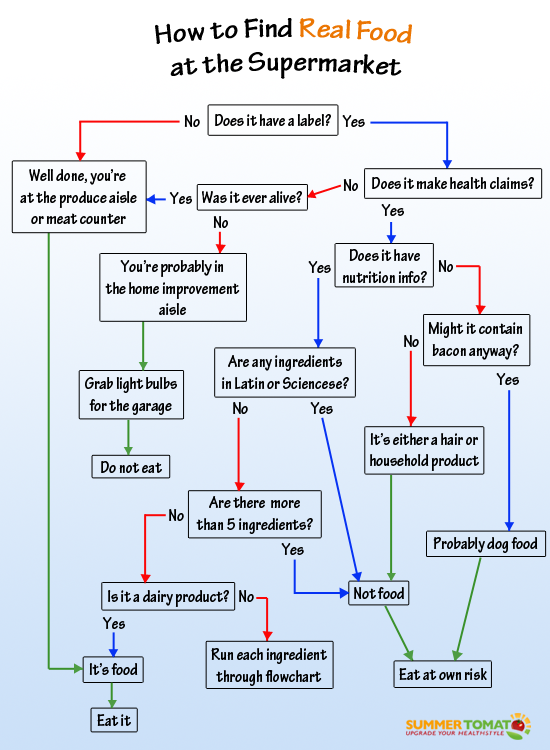
For a laugh, check out this flowchart from Summer Tomato to decipher whether your food is Real Food. 

Food can be a tremendously stressful situation for us at every single meal.  But it doesn't HAVE to be!  Choose REAL FOOD choices as much as possible to do your body and the world some good.  Starting to be more mindful of what you are eating and what your food is made of starts you on the road to taking control of your diet.  Try to nourish yourself, not harm.

Find me and many other paleo bloggers on our weekly Paleo Rodeo hosted by Modern Paleo!

Thursday, January 27, 2011

My Zone Challenge Food Log

The book by Barry Sears, Ph.D., creator of the Zone Diet. 

I've been living in the Zone for almost two weeks now and want to update you on what I've been eating and how I've been feeling to add support to the community of Paleo-Zoners.

Here's my Zone experience!

The Dreaded Scale and Tape Measure

I hate both and avoid both as much as possible.  But, I must oblige in figuring out my blockage, so here's my starting numbers, taken on 1/15/11:
weight: 147.2
hips: 40
waist: 34 1/8
height: 5'6"

Body Fat by the numbers, using the Zone book tables: 31.39%

Lean Body Mass: 101.43 (31% of wt. gives lean percentage, which I multiplied by my wt.)

Using a Zone Diet multiplier of .7 for moderately active (I bike 5X a week for over a half an hour and CrossFit generally 3 days on 1 day off) and multiplying that by my Lean Body Mass gives me my block count:
10 Blocks

THE RESULTS

So far, the weight loss is slow, but that wasn't really my goal. I was at 144.6lbs after one week (about 3 lbs. lost).  I'm performing pretty well at the gym and feeling pretty good.

Some lessons I've learned:

  • As always, the more vegetables, the more satisfying and satiating the meal.  
  • Fruits alone, or high starch meals, only whet the appetite and hunger soon returns.  
I always wish I could eat more protein and fat--they are my dear friends--but at the same time I feel like I am stuffing my face with carbs.  I NEVER have eaten so much fruit as I do now, and my servings of vegetables could feed a family of five.  I am still limiting my fruit to lower glycemic choices (mostly berries, apples, and the occasional grapefruit), but it still feels like sugar to me. 


I can remember being a hunger-crazed Zone zombie (also known by Robb Wolf as the Always Hungry Carb Crash Zombie) the last time I tried the Zone Diet, before I found the Paleo Diet.  I was filling my carb blocks with the easiest of sources: grains and fruits, which burn more like lighter fluid than a Duraflame log in your belly.  That and my obsession with fats definitely did it in for me last time.

This time, it is going better.  

  • Wait it out: the first week is rough and if you are coming from a state of even more nutritional derangement, it can take even longer to adjust. 

The first week was hard on my hormonal state (such as tears over nothing), and I still get stressed out at the drop of a hat, but I feel energized and awake most days.  I HATE not being able to eat the portions I want, but for the most part, I am never starving unless I let the hours get too long between meals.  I'm rarely even hungry.

  • Having readily prepared foods helps immensely because it is just as easy to eat on the Zone as it is to cheat, so it's easier to be responsible and stick with it.  
  • Cooking can be tough, so use alternatives to high fat cooking such as grilling, Silpat or parchment lined baking/roasting, and minimally greased skillets. 

The lack of fat makes cooking even with a nonstick skillet pretty tough.  Lately I've increased my fat a little when cooking to avoid losing a quarter of my protein to the pan.

  • Don't beat yourself up over transgressions, just climb back on the plan again. 

I started my Zoning out on the wrong day: a taco social at San Francisco CrossFit after Brian MacKenzie's Running Seminar.  I tried to be good and eyeball-portioned out six blocks of corn tortilla and meat, but I didn't let the inaccuracy or deviation into enemy territory with the grains defeat me.  It was an anticipated cheat and I did my best to eat responsibly.  I was back on the wagon again the next day! I also had a hankering for cheese lately and took this opportunity to add it back in for this challenge.  I don't make cheese a part of my daily life, but I enjoy it on occasion.  This makes me a Lacto-Paleo-Zoner :)

  • Making your diet observable, measurable, and repeatable allows you to improve your performance. 

All in all, it's a great experience of solidarity at my CrossFit gym where most of us are Zoning together.  It's also a good learning experience to see just how much my protein and fat have oozed outside their respective proportions while I've been lax on the weighing and measuring.  I can definitely see how making your diet observable, measurable, and repeatable makes sense if you want to take your performance to the next level.  You can see how the baseline makes you feel and how it allows you to perform so you can make any tweaks necessary for improvement.


THE FOOD LOG

In addition to the foods I eat, I drink water and decaf teas throughout the day and take a few supplements: multivitamin, vitamin D, B vitamins, fish oil, and vitamin C (before bed).

NOTE: for those of you not familiar with the Zone and it's lingo, Nutritionize is a great resource for Zone Diet resources and Zoleo, their Paleo-Zone approach.  For terminology I use here, P = Protein, C = Carbohydrate, and F = Fat.

I think it works best to show how my meals look, grouped by meal, not day (those get so boring, don't they?).  I try to maintain variety, but I also stick with some standard meals I really enjoy.  I initially broke my day into a 2-block breakfast, 2-block lunch, 2-block snack, and a 4-block dinner to dessert.  This "hoarding" behavior is quite common on the Zone when someone is scared to have few blocks left at the end of the day when hunger festers and no one wants to fall asleep to the purr of their growling stomach.  But by mid-week, I realized my dinner was quite filling at only 3 blocks, so I could eat a larger, and more satisfying lunch.  

Here are my meals:

Kale and Eggs with Cinnamon Apples

Breakfast (2 blocks)
(with or without the cinnamon or smoked salmon)
Protein:
  • 2 blocks = 2 eggs 
or
  • 1 block = 1 egg
  • 1 block = 2oz smoked salmon
Carbohydrate:
Fat:
  • 2+ blocks = pasture butter  NOTE: I started off with just a teaspoon, but when cooking kale, then emptying the skillet to cook eggs, I found I couldn't avoid stickage unless I used 1t for each. I am now a happier camper :)
Artichoke Chicken-Apple Salad
Lunch (2-3 blocks)
SALAD!
Protein:
  • 2-3 blocks = 2-3oz rotisserie chicken, canned wild-caught salmon, or homemade, roasted turkey breast  NOTE: I used a dry rub on the turkey and tried it slow-cooker style with garlic and ginger and cabbage.  
Carbohydrate:
  • 1 block = as many salad greens as you can jam into your container/bowl tossed with 1/6c lemon juice
  • 1-2 blocks = apple sliced thinly and mixed in the salad or grapefruit (1 whole grapefruit per block) sliced into the salad so the juices add to the lemon dressing or artichoke hearts (1.5c per block) mixed in (or some combination)
Fat:
  • 2-3 blocks = 2-3t crushed walnuts or 1t olive oil
Roasted Turkey-Apple Sandwiches 
Snack (2 blocks)
Protein:
  • 2 blocks = 2oz rotisserie chicken, canned wild-caught salmon, or roasted turkey breast 
Carbohydrate:
  • 2 blocks = Organic, young coconut water (2 blocks even!) or 170g baby carrots, or just a whole apple 
Fat:
  • 2 blocks = chicken or turkey skin or 2t crushed walnuts or 6 cashews or 2T avocado/guacamole

Dinner (3-4 blocks)
Protein:
  • 2-3 blocks = Hearty Paleo-Zone Chili
  • 1 block = 1oz raw, organic cheese  [NOTE: I would have preferred to find raw, grass-fed cheese, but couldn't this time] or 1/2oz raw, organic cheese and 1/2oz of organic salami
Carbohydrate:
Fat:
OR
Mushroom Burger Salad with Avocado

Burger Night

Protein:
  • 2-3 blocks = 3-4.5oz grass-fed beef burger, grilled
  • 1 block = 1oz raw, organic cheese  [NOTE: I would have preferred to find raw, grass-fed cheese, but couldn't this time] if using only 2 blocks of burger
Carbohydrate:
Fat:
  • 3+ blocks = bacon fat for broccolini if having that 
or
  • 2 blocks = 2T avocado
  • 1 block = 1T coconut milk for the Berry Bowl if having that (if not, add more avocado)


OR 
Sausage and Egg Skillet

Breakfast for Dinner
Protein:
  • 2 blocks = sausage (something organic and grain-free, sugar-free)
  • 1 block = egg
Carbohydrate:
  • 1-2 blocks = kale, spinach, or other dark, leafy greens perhaps with some mushrooms (1 block per package of sliced mushrooms)--you could definitely add more veggie variety here
  • 1-2 blocks =  Berry Bowl or Ceylon Cinnamon Dusted Apple Slices
Fat:
  • 2+ blocks = pastured butter
  • 1 block = 1T coconut milk for the Berry Bowl if having that (if not, allow more butter)

So there you have it: some meals on the Zone.  I am sure many more of my recipes are Zone-friendly, so check out the ingredient list Labels and Important Information areas on my sidebar to find them.  Hopefully I've given you some ideas to fuel your own Zone challenge or just some interesting pairing or meal ideas you can use whether you weigh and measure or not.  Let me know how you like them!

Thursday, January 20, 2011

A Dinner in the Zone: Hearty Paleo-Zone Chili on Roasted Portobello Mushroom Caps with Crunchy Slaw


Those of you Zoning with me may be a little sick of the piecemeal, thrown together meals we often fall back on.  The ease of just finding a Protein source from the list, Carb source from the list, and Fat source from the list and combining odd choices just to get the balanced blocks can take it's toll on your meal-time satisfaction.

But I am here to offer another option: cooking a Zone meal that will make many dinners to come as easy as portioning and reheating.  And did I mention that it's filling AND delicious?  Sometimes with the calorie reduction inherent in the Zone Diet and the emphasis on fruit and starchier carbs for easier blockage, people feel hungry all the time and starved.  This meal utilizes lower glycemic ingredients (vegetables) to satisfy you at the end of a long day of weighing and measuring. And it's filling whether you're eating only a two-block portion or a five-blocker.  Yes, eating well CAN actually happen on the Zone!

THE MEAL

I began my Paleo-Zone challenge last Saturday and will post my food log soon, but for now, let me share with you this amazing meal I've had for dinner this week.  And with the amount my husband and I made, we'll probably still be having this meal well into next week :)  This meal is Hearty Paleo-Zone Chili on Roasted Portobello Mushroom Caps with Crunchy Slaw spooned on top (all recipes follow).  It's delicious and hearty--which is no simple task when cooking and eating on the Zone.  At two blocks or five, this meal will fill you!

The chili is a rich and spicy mix of vegetables and grass-fed beef.  It is FILLING, which is the perfect quench for end-of-day hunger, and it's warming to combat chilly evenings.  I was inspired by paleo chilis that hold the beans, Alton Brown's amazing Pressure Cooker Chili (sans the pressure cooker for us) that turned us on to using chopped beef instead of ground beef, and the Chan's Chili recently posted in the CrossFit Journal, which helped us Zone proportion our chili. Whether you Zone or not, this chili is amazing and you definitely won't miss the beans. 

Instead of straying off the Paleo Diet for rice or tortillas, I serve the chili on Roasted Portobello Mushroom Caps that add a meaty base.  SO much more filling than rice or tortilla, these mushrooms are a great base for any meaty sauce.  The chunky, silky texture of the chili is complemented perfectly by crunchy, lime and onion slaw I call Crunchy Slaw.  It is SO easy to make and adds that taste and crunch that definitely kicks the chili up another notch. 

For the recipes below, I used P, F, C to stand for Protein, Fat, and Carb, which the Zone Diet uses to balance food.  A block of Protein = 7g protein, a block of Fat = 1.5-3g depending on the fattiness of the Protein, and a block of Carb = 9g after fiber is subtracted.  For Zone Block charts, check out this compiled list: http://www.mitymous.net/weights/zoneblox.htm

NOTE: there is definitely some flexibility to these measurements as some of the foods I used below have different measurements based on different Zone block lists.  Since this meal is mostly veggies, I am not going to fuss about which count is correct and whether I have measured it precisely.  The Zone is enough effort just to weigh and measure everything.  In this case, allow yourself some leeway on the veggie counting and err on the side of MORE.  :)

Without further ado, here are the recipes!

Hearty Paleo-Zone Chili--this is only one of three containers we filled to the brim!

Hearty Paleo-Zone Chili
Definitely not for a quick meal, this endeavor will provide you with chili to feed an army or yourselves for a week (maybe two?) on the Zone.  The medley of grass-fed beef, assorted vegetables, and spices will heartily fill and warm your belly. 
Prep Time: 1hr give or take your mad knife skills and helpers
Cook Time: 2-3+hrs, slow cooker for the day/night or stovetop for a few hours until tender and delicious.
Quantity: see Our Totals below.  You can use the ingredients in your own proportions to make the quantity you desire.  We're going for a 2P:1C:1F ratio so you can serve this on Roasted Portobello Mushroom Caps with Crunchy Slaw on top.

Ingredients:
NOTE: I'll give what makes a block and how much we used, but you have to be your own guide for making this Zoned to meet your desired quantity and taste.
  • yellow onions, chopped (1.5c = 1C, 10 onions gave us 10c = ~6C)
  • mushrooms, chopped (3c = 1C, one container of sliced mushrooms = 3C and we used 4 = 4C)
  • can of crushed tomatoes (with Basil) (check your label, ours was 1/2c = 1C and we used (2) 28oz. cans or 10C)
  • zucchini, chopped (2c = 2C, we used 6 small ones and got 8 cups or 4C)
  • grass-fed chuck roast, chopped (1oz = 1P and we used 56oz = 56P)
  • container of salsa (check your label, ours was 1/2c = 1C and we used 2c = 4C)
  • cumin
  • chili powder
  • salt
  • pepper
  • garlic powder
  • olive oil (1T = 9B and we used 3T = 27F)
  • optional: chili peppers or other heat multipliers (NOTE: the chili powder and cumin made this pretty spicy on their own, so play around with it to your taste)
  • a writing instrument and sheet of paper to record your amounts and calculations

Our Totals: 56P, 28C, and 28F is a 2:1:1 ratio, so we need to add a Carb and Fat to every portion of chili.  That is perfect for a serving with Roasted Portobello Mushroom Caps (1/2C, 1F) and Crunchy Slaw (1/2C) (see recipes that follow).  Our finished batch was 187oz. and dividing by the 56P that went into the pot gives us 3.33oz for 1P, 1/2C, 1/2F.  Your batch will vary on your ingredients and finished thickness and weight, so do your own math on this one.  Sorry, Zone cooking isn't a piece of cake, but it is well worth the effort to not stress about dinner for a week (or more)! :)

Method:
Chop till you are blue in the face.  You should start on the onions and add them to a large stock pot set over medium high heat and coated with olive oil (1T worked) and a little salt.  I like to season as I add new ingredients into the pot, a lesson learned from years of watching Emeril as he bammed the crap out of his dishes.  Stir the onions every time you add more to the pot and add more oil if they start to stick.  Record how many cups of onions you use and keep a running tally of the oil.  Remember to try to be frugal with the oil if you want to stick to plain Jane Zone. Those of you lean enough to be using Fat multipliers can have more flexibility--damn you ;).

Meanwhile, a second pair of hands can chop the chuck roast into tiny bits, cutting out any really awful sinewy parts if desired.  Once that's cut, weigh it to use your desired amount and write that number down so you can figure out total blocks later on.  Using another skillet, coat with olive oil (1T worked) and brown the beef (use multiple batches so you only have one layer of meat in the pan, add more oil for each batch--it took us two batches using a big skillet).

Next, to the onions in the stockpot, add the sliced mushrooms (I bought them already sliced, so no prep there!--measure them out if you want to be precise, but for each styrofoam-like container it was about 3c).  Stir and cook them down.  We're looking for translucent if not browning onions and reduced size in the mushrooms as they cook.

The first pair of hands can move on to chopping the zucchini or you can get to it after the meat is done.  Measure out how much you use by the cupful.

Once the meat is done, add it to the stock pot (batch by batch is fine), then add the zucchini, tomatoes, salsa, and spices.  For the spices, be your own judge based on how much you are making at once.  Remember, it's always easier to add more heat later than find Zoneable ways to reduce it after the fact. Unfortunately sour cream and guacamole are Fats that will easily devour your blocks unless you allot them.  Let your chili reduce over Medium heat until you like the thickness, then Low for as long as you like to meld the flavors and tenderize the beef and veggies.

Once done, you have one more fun task: measuring the result of your labor of love.  We tried to be sneaky and weigh the empty pot, then the full pot, but the pot was too heavy for the scale :(  So we weighed storage containers and then filled them, took their weight and got the whole picture the hard way.  You could also measure by Pyrex liquid measure as you remove the chili from the pot and place in storage containers.  Either way, from that number of total weight, divide it into total blocks of Protein and figure out ounces or cups per block of Protein.  From our ingredients, we came up with a 2:1:1 ratio and found that 3.3oz. gives us 1P, 1/2C, 1/2F.  Yours will vary based on the quantities and thickening of your chili.

We served ours over Simple Roasted Cauliflower (3c =1C, plus a little fat) or Roasted Portobello Mushroom Caps (1/2C) (recipe follows) with Crunchy Slaw (1/2C) (last recipe) on top.  


Roasted Portobello Mushroom Caps
For a meaty base perfect to hold chili, burgers, ragout, or anything else you desire, try better-than-bread roasted portobello mushrooms!
Cooking Time: 15min+, really as long as you like to get them tender and juicy
Quantity: 2-3 roasted caps, depending upon size, is about 1/2C if 3 cups = 1C

Ingredients:
or parchment paper and baking sheet
  • portobello mushroom caps (rinsed and stems removed) (3c = 1C, so 2-3 caps after roasting seemed like 1/2C)--NOTE: make extra so that you have meals for a few nights.  The mushrooms will keep well sealed up in the refrigerator.
  • olive oil (1/3t = 1F), optional
  • salt 
  • pepper


Method:
Preheat your oven to 425 degrees. Line a baking sheet with Silpat or parchment paper so you don't have to use fat to grease the pan.  Place mushrooms on the sheet, gills up.  Sprinkle caps with salt and pepper and drizzle on the olive oil you need to accumulate your desired fat blocks.  If you don't have any fat to spare, the caps are fine without any oil.  The liner is our insurance :) Place the sheet in the oven and bake until juicy and tender.  These are perfect to make in bulk while you are preparing and cooking the chili!  Afterwords, you'll have a delicious base to your chili that is spoon tender, meaty, and filling!


Crunchy Slaw
The perfect crunchy slaw for your spicy dish!
Prep Time: 5-10min tops
Quantity: Made enough for at least 4-6 plates, so about 1/2C for each serving. 

Ingredients:
  • 1/2 head of cabbage (4c = 1C)
  • 1/2 onion (1.5c = 1C)
  • 1/2 bunch of cilantro (unless you are using a bucketful, it's unlikely you'll come close to a block)
  • 1 lime, juiced (1C)
Total Blocks = 3C

Method:
Chop the cabbage, onion, and cilantro as finely as desired and mix well.  Add lime juice and mix again.  There you have it!  This is a perfect, crunchy, tasty accompaniment to tacos/chili/anything Mexican inspired!

So there is your meal: Hearty Paleo-Zone Chili served on Roasted Portobello Mushroom Caps with Crunchy Slaw on top!  Here's to enjoying what you eat on the Paleo-Zone Diet!

Wednesday, January 12, 2011

Entering the Zone

Today's recipe: Berry Bowl

 UPDATE: CrossFit Santa Cruz and my website were featured in The Santa Cruz Sentinel today!  Check it out here: Healthy Lift: CrossFit Santa Cruz, others touting unprocessed meat, veggies as top diet essentials from 1-12-11.  I'm SO excited and appreciative!

It's post holidays and back on the meal plan of meat and veggies, nuts and seeds, some fruit, little starch, and no sugar.  I usually just eat meat and veggies and lots of healthy fats: omega-3 fish oil, pastured butter, olive oil, and coconut oil.  Over the holidays, some ice cream and gluten-free treats crept in and it was surprising how little it took to completely override my taste buds.  When I am "on the plan," I crave nothing but meat and fat and fatty meat.  When I am "off the plan," sugar supersedes my love of meat and fat and I go hog wild for chocolate and gluten-free fudge cookies or flourless chocolate tortes crumbled into vanilla ice cream.  I know I am on the dark side when I wander the sweets aisle lusting after every forbidden delight.

So now I'm back on track and I've found a great way to get my taste buds back on track in a healthy way.  If I crave sugar, I'll give myself sugar the healthy way: Fruit!  There is nothing so divine as a steaming bowl full of blueberries and coconut milk, sprinkled liberally with Ceylon cinnamon of course! (what don't I put cinnamon on?)

My CrossFit gym is embarking on a new event for a new year: two weeks of weighing and measuring, Zone-style starting this weekend.  For more details on the Zone, check out founder Barry Sear's site: http://www.zonediet.com/).  Basically you categorize foods as either proteins, fats, or carbohydrates (or some combos) based on their highest macronutrient.  Then you try to balance your protein, fat, and carbohydrate at every meal and eat only enough to support your lean body mass.


 Now I've been on the Zone and it has worked great--I was even a gym winner in the Zone improvement challenge years ago.  But then I found the Paleo Diet and became lax on the weighing and measuring and proportioning side of my diet.  I still weigh and measure almost all of my meat on a daily basis so that I don't often indulge knowingly in over 12 blocks.  But I have definitely been slacking in the other areas, lower in carbohydrate and higher in fat.


So here is my challenge: I am going to embark on Paleo-Zone at least for two weeks.  Unfortunately, my last Zone foray was before Paleo-style, so many of my old recipes included grains.  Since I can't fall back on them, this is a fresh new start.

I know I have been splurging a little in the fat department if only a 1/3 of a teaspoon of butter is a block.  Just a little splurging ;)  I also haven't been eating much in the way of carbohydrates according to the Zone.  Right now I fill the skillet with kale and chard in the morning, have a whole container full of arugula or spinach or both for lunch and often have broccoli or cauliflower for dinner, but this is a drop in the bucket for the Zone.  One block of cooked kale is 2 cups.  One block of arugula is 10 cups. One block of cooked broccoli is 3 cups.  So I think if I am going to give this challenge a good try, I have to start eating the other forgotten parts of my prescription: little fruit and some starch.  I'll stick with vegetable-based starches (plantains and root veggies sound enticing) and low glycemic fruits (like berries and apples) as much as possible to get in some more blocks without having to eat 10 cups of greens for every block :)

So my recipe today can be Zoned.  I tried it out with a rotisserie chicken from New Leaf market as my protein (1oz per block), frozen blueberries (1/2 cup per block), and coconut milk (about 1T per block*).  I had my protein SLOWLY to make it last longer before my berry bowl and then enjoyed my berries as if a dessert.  The fat makes it satisfying and the sweet hits your sweet-tooth on the spot.  Delicious!

Berry Bowl shown using a two-block serving

Berry Bowl
Sweet enough to drown your craving for sugar, rich enough to keep you satisfied after you lick the bowl. 
Preparation: 5min using a microwave, probably less than 10min for stove-top

Ingredients:
Organic frozen (or fresh) blueberries, 1/2 cup per block
Organic coconut milk (preservative free if possible, read those labels closely!), about 1T per block*
Ceylon cinnamon (for more on why it should be Ceylon instead of regular, old Cassia, see this post: Apple of My Eye), free on the Zone diet (yay!)

Method:
Measure your desired blockage of blueberries and place them in a microwave-safe bowl (read: NOT plastic) or small pot or skillet to heat on the stove.  Sprinkle on the cinnamon.


Heat the berries until hot but not mush (1-2min in the microwave if you are going that route, depending upon quantity and microwave).  When they're hot, measure and add your coconut milk (alternatively, you could add it before heating, but I like it thicker like after refrigeration instead of thin like it gets after heating).  Stir, taste, and add more cinnamon if desired and I ALWAYS desire :)  Enjoy a healthy, seems-like-an-indulgence-but-isn't bowl!


Check back for more Paleo-Zone support!

*My brand of coconut milk has 14g of fat for a 1/3 cup, so if I take 3g of fat per block, that's about 4.6 blocks in that 1/3 cup.  Since 1/3 cup is about 5.3 tablespoons, that means one block is just over a tablespoon (assuming my horrendous math skills are correct).  I take that as a green light to be a little bit more liberal in my tablespoon measurement.  But of course, the consistency of the coconut milk would make a difference too: after refrigeration it's thick, but a fresh can might be watery.  Brands vary too.  Therefore, be your own Zone judge.  The bigger picture is just to be mindful of what you are eating :)

Join us for this two week experiment!  To find out more, visit CrossFit Santa Cruz.  For more information on Paleo-Zone, or "Zoleo" as our friends at Nutrionize like to call it, check out their informative post on the subject: The Zoleo Philosophy.  And please ask if you have any questions!

This post and many others are part of Modern Paleo's Paleo Rodeo posted at the end of each week.  Please check it out HERE.